
The hybrid plant that combines wave, wind and solar power
Wave Power Meets Wind and Solar: A Hybrid Power Plant for the Future
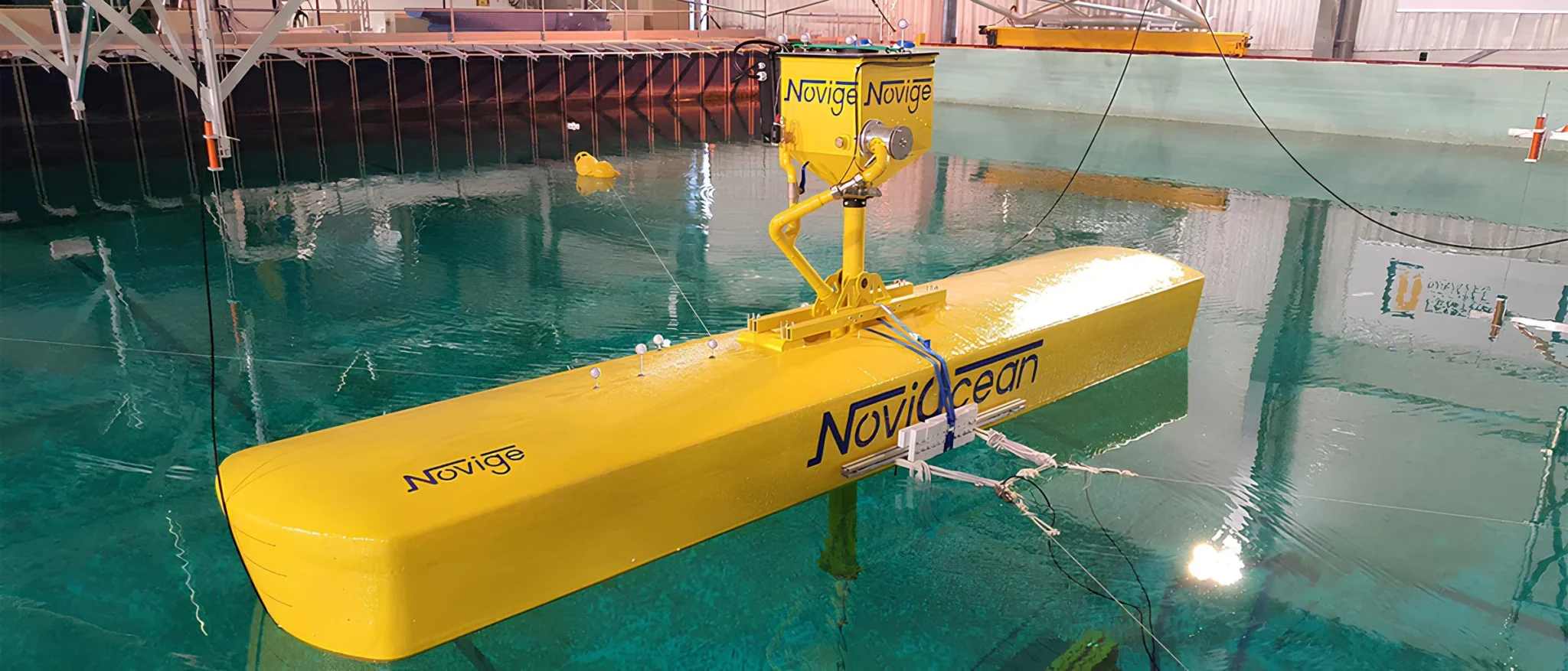
For illustration only — the actual design is shared in closer dialogues.
Published as Novige AB. The company is now NoviOcean AB.
INNOVATION A wave power plant that can be combined with wind power and solar cells. Last autumn, the Swedish company NoviOcean by Novige won the Startup4Climate, competition with its innovative power plant. Now the company’s founder Jan Skjoldhammer hopes that the company can scale up the solution in collaboration with offshore wind farms.
In mid-November, NoviOcean by Novige’s CEO Jan Skoldhammer stepped forward and accepted the Startup4Climate award together with the company Cemvision, which manufactures fossil-free cement. The jury fell for the combination of wave power, wind power and solar energy which complement each other.
But succeeding in wave power is tough, many companies with wave power plants have failed in the past. What speaks for NoviOcean by Novige’s success, Jan Skjoldhammer believes, is the robust and simple technology and the fact that it is a hybrid that produces electricity from several energy sources.
Six vertical wind turbines
The Noviocean wave power plant looks like a raft and is 38 meters long and four meters high in full size. At sea, it should lie along the side of the waves. Underneath the power plant is a water-filled cylinder with a piston rod and cable that is connected to the seabed. In addition, there are four anchors out with the sides of the raft, to keep the power plant in the correct position at the surface.
On top of the raft there are six vertically oriented wind turbines, which together have an output of 300 kW and solar panels of 50–80 kW.
This gives a total effect of approximately 1 MW and an average effect, so-called capacity factor, of approximately 40 percent of this.
– In the wave power plant itself, water is pumped in a circular flow in the cylinder. It actually works on the principle of an old garden pump. When the raft, which lifts with up to 600 tons, goes up, the water is also pumped up, says Jan Skjoldhammer and demonstrates with his hand what it looks like when the water is pumped in the same way as in a garden pump.
– When the water has risen, it goes to a pelton turbine with up to 300 km/h and 800 liters per second. On the same axle is the generator that converts the kinetic energy into electricity. The components of the wave power plant are based simply on a raft, a garden pump and an upside-down hydropower plant, but of course we also have innovative technology to make this work optimally and the technology is patented in 20 countries, says Jan Skjoldhammer.
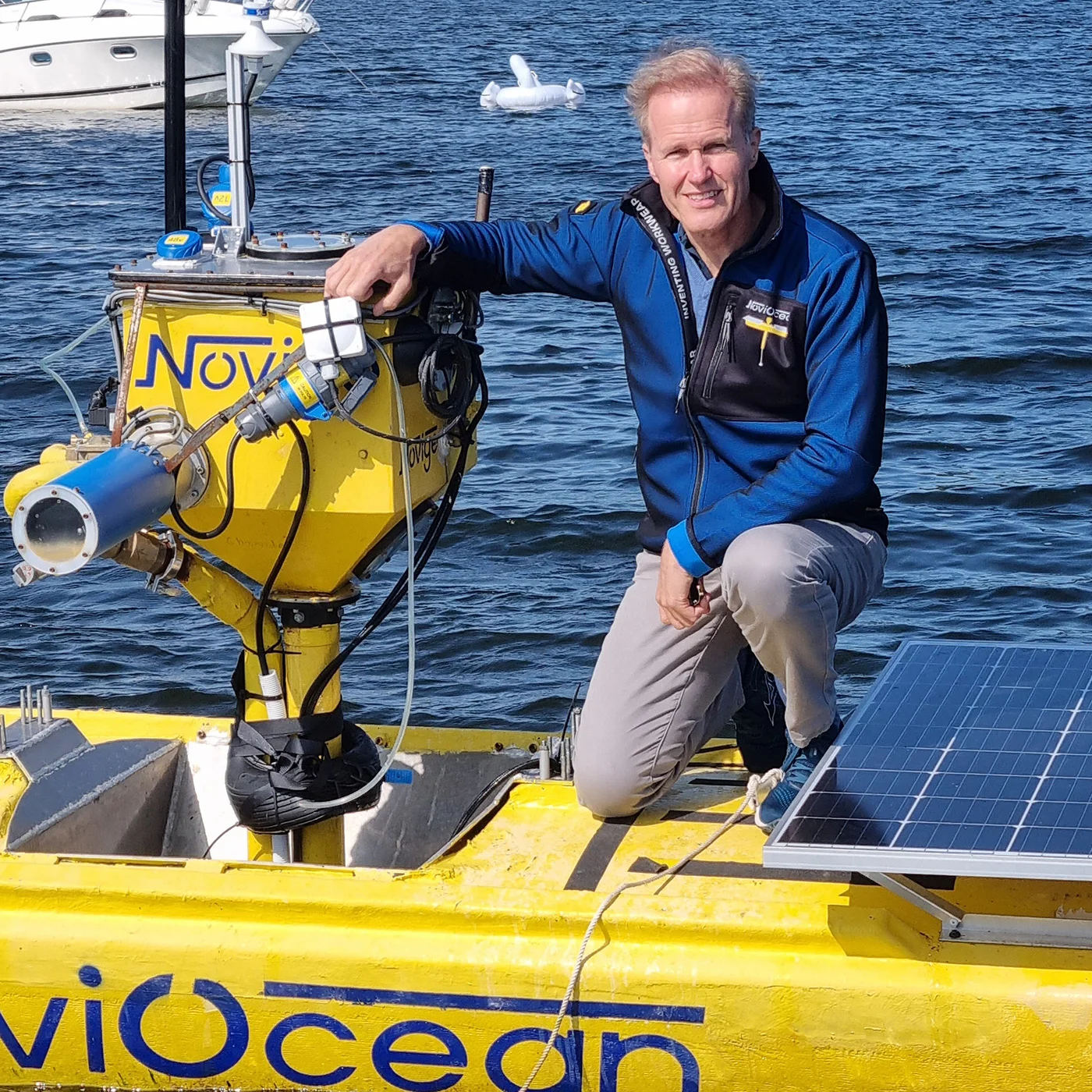
Tested at KTH Royal Institute of Technology in Stockholm
The wave power technology has been developed over several years and has been tested in wave pools in England and France. It has also been tested for 24 months in a test rig at KTH and since a year ago it has been tested in a real environment outside Lidingö, in Stockholm. The power generated in the wave power plant goes to the houses on the small island of Svanholmen.
– It is a miniature copy of the wave power plant, with solar panels on the top, and is only six meters long, but lifts about one ton. Here we see that the technology works at sea, as we have seen and validated in wave pools and in test rigs, says Jan Skjoldhammer.
On one square kilometer we can place 15 wave power plants with an output of 15 MW of electricity, while offshore wind power has an energy density of 10 MW. Together we can get up to 25 MW and we can share the costs for the sea area.
The idea with NoviOcean by Novige’s technology is to place a number of hybrid power plants in the vicinity of large-scale wind turbines and the electricity produced from these energy parks is transported to land through a common cable. Because there are several production units that use the same cable, it also results in a better economic calculation than if the owners of the wind turbines or wave power plants were to take on this entire cost themselves. At the same time, less sea surface is used and the receiver can get double the effect.
– On one square kilometer we can place 15 wave power plants and they can have an effect of 15 MW of electricity, while offshore wind power has an energy density of 10 MW. Together we can get up to 25 MW and we can share the costs for the sea area and the cable to land, says Jan Skjoldhammer and continues:
– It also gives a more even effect because the waves remain for several days after the wind has died down and then produce electricity during the time when the wind turbines are not producing as much. You can also put separate facilities at sea with only the wave power plant, which has the advantage over wind power that they can be located closer to land without visually disturbing the coastline.
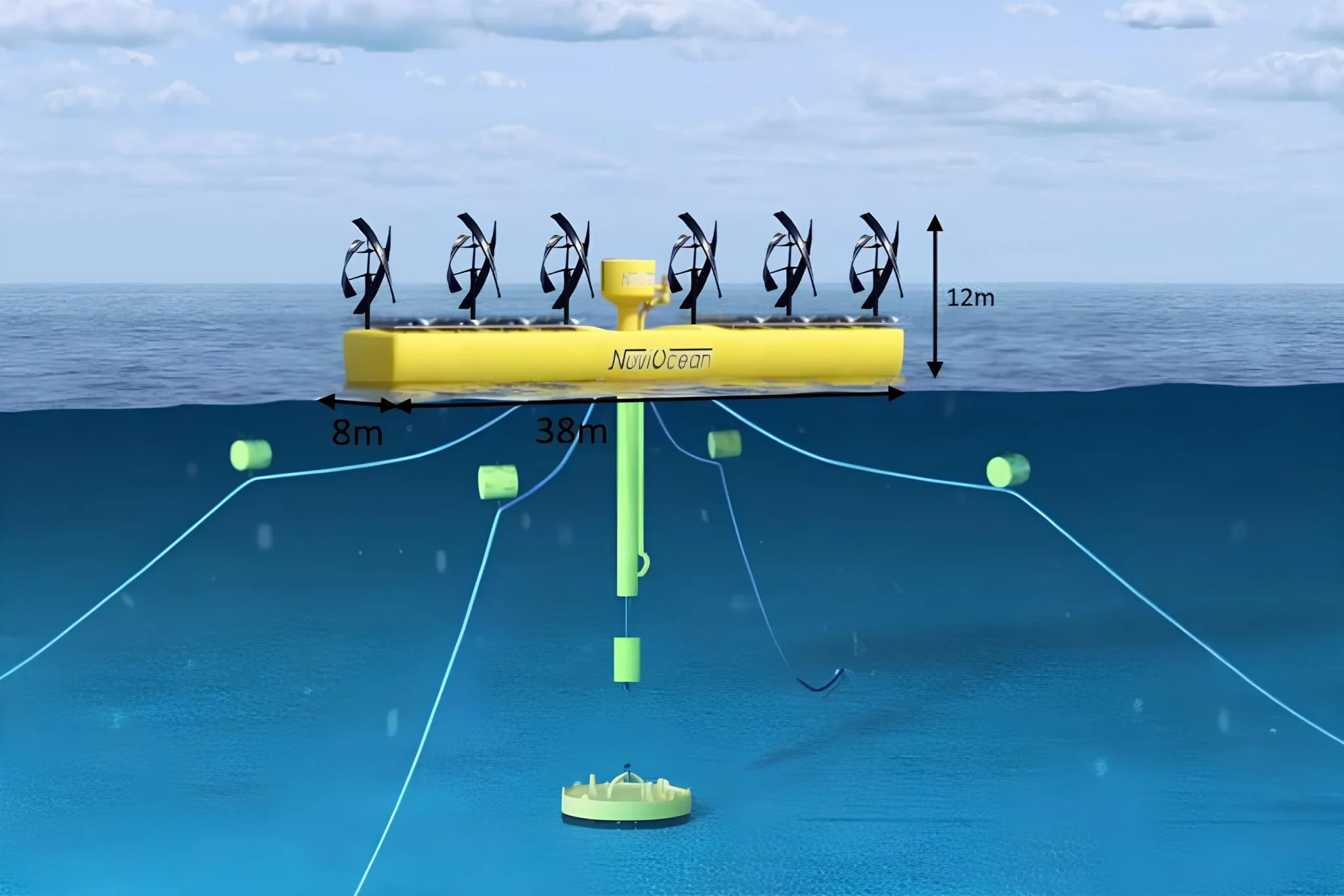
For illustration only — the actual design is shared in closer dialogues.
Simple and effective technology
In many ways, NoviOcean by Novige’s wave power solution has the potential to be revolutionary for climate work and the energy transition, says Johan Lindehag, member of the jury and CEO at Ellevio.
– Unlike other wave power, which is often both heavy and complicated, this is a solution that is both lighter and can produce a higher effect. It is simple and efficient, and it also adds solar panels and wind power, says Johan Lindehag.
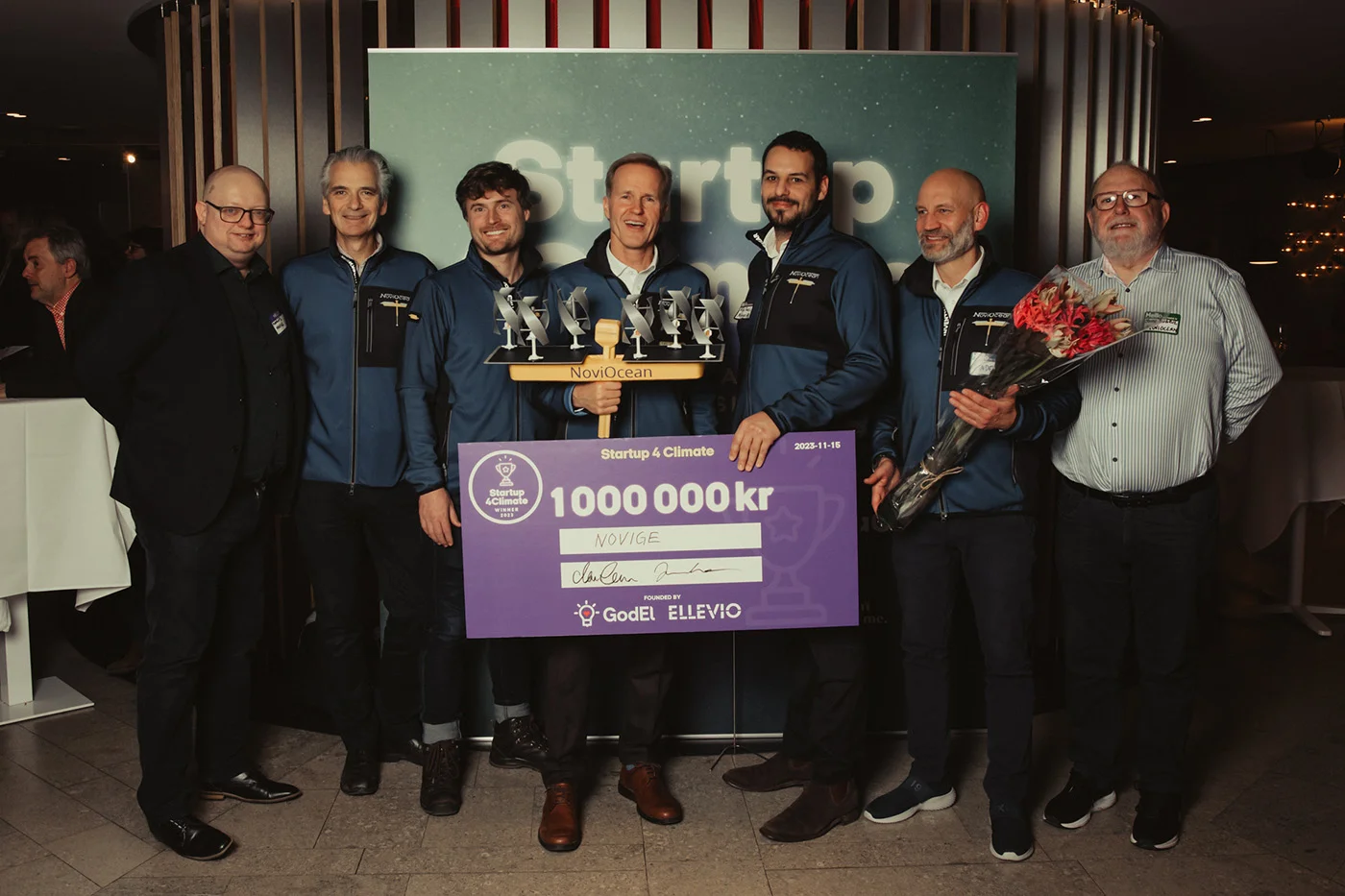
It is the fourth year that Ellevio and Godel have arranged the competition and this year 75 entries participated. It is two companies with the best idea and the greatest measurable climate benefit who win and receive the prize money, one million kroner each.
– For our company of seven people, the win means recognition from the energy industry – a kind of verification that what we are doing is right. This is the fifth time we have been praised by experts in energy and climate, and the fact that we get confirmation time and again that we are doing the right thing shows that we have potential, says Jan Skjoldhammer.
Implementation on a large scale
The next step for the company is to implement a full-scale pilot project. NoviOcean has therefore recently contacted several large companies in the field of offshore wind power to see if they would like to enter into a partnership to build a pilot offshore plant that includes wave turbines, vertical wind turbines and solar cells. Then it is no longer about investments in Swedish waters, because here the waves are not high enough, but rather it can be in countries on the large continental coasts, such as for example off the coast of North and South America.
– But Sweden can also take part in electricity produced from the wave power plants, because off the coast of Norway there is a perfect combination of waves and wind for our technology and then the electricity could be delivered in the existing grid to Östersund and Karlstad. This way we could provide stable and green electricity to SE3 and SE4, says Jan Skjoldhammer and sounds enthusiastic.
Overall, Jan Skjoldhammer sees great opportunities for his innovation, but there are certainly challenges.
– The main challenge is capital. We have received approximately SEK 30 million in grants from the EU and Sweden through, among others, the Energy Agency and Vinnova and have taken out a green loan from Almi. Now we get one million kroner through the profit from Startup 4 Climate.
– But it is expensive to work with the development and establishment of new technology. Now we very much hope to take the next step together with a company in wind power, concludes Jan Skjoldhammer.