
The hybrid case, and the machine built around it
A short film made the hybrid argument. This is the written version, plus the machine that came out of it: the Medi Wave 850H, designed for the medium and low wave conditions that cover most of the world’s coastlines.
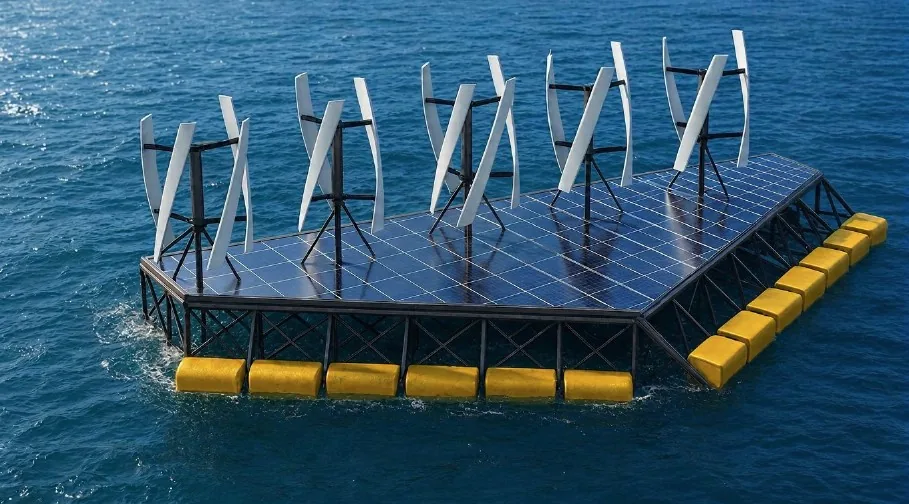
The original post carried a four-minute film about combining wave, wind and solar on one offshore structure. The argument in it has not changed, and it is short: an offshore project spends most of its money on things that are not the generator, and those things can be shared.
What has changed is that the argument now has a specific machine attached to it.
Medi Wave 850H
Built on the same validated principles as the earlier, larger design, but aimed at medium and low wave conditions — which is most of the world’s coastline, including the Asia-Pacific region and the global east coasts. A high-energy machine is the wrong tool for a moderate sea; the Medi Wave is the right one.
Rated 850 kW: 300 kW wave, 350 kW wind, 200 kW solar. management estimate Scalable from a single unit to offshore arrays, from 850 kW to 5 MW, with optional containerised desalination or battery storage on deck. The full description is on Medi Wave 850H.
What one unit corresponds to
Over a year, one unit corresponds to approximately 2,500 MWh of electricity modeled — or, where a site needs water more than power, desalination of 70,000–100,000 litres per hour. modeled
Those are two descriptions of the same unit, not two outputs to be added together. Energy spent making water is energy that does not leave as electricity. The either/or is explained properly on Desalination & Water Security.
What it costs the customer
Approximately 4–8 c€/kWh at Stage A, the commercial pilot, falling to 2–5 c€/kWh at fully commercial scale of 200–1,000 units. projected Those figures are unit-level generation cost, excluding site-specific infrastructure such as grid connection, export cabling or local permitting.
Three conversations we are open to
- Customers. Early sites — islands, ports, aquaculture, coastal industry — where energy already costs the most. Start at Book a Meeting.
- Shipyards and supply-chain partners. The structure is conventional welded steel, which means it can be built by national shipyards and local suppliers rather than shipped in. That is deliberate: it keeps value in the region that buys the energy.
- Investors. The position, the funding stages and how to request the current material are on Investor Relations.
Platform images on this page are for illustration only — the actual design is shared in closer dialogues.