
Ocean energy is still building one machine per source
Most ocean-energy development still asks the same question: how do we make this one device better? NoviOcean’s founder asked a different one — why is there only one device on the structure?
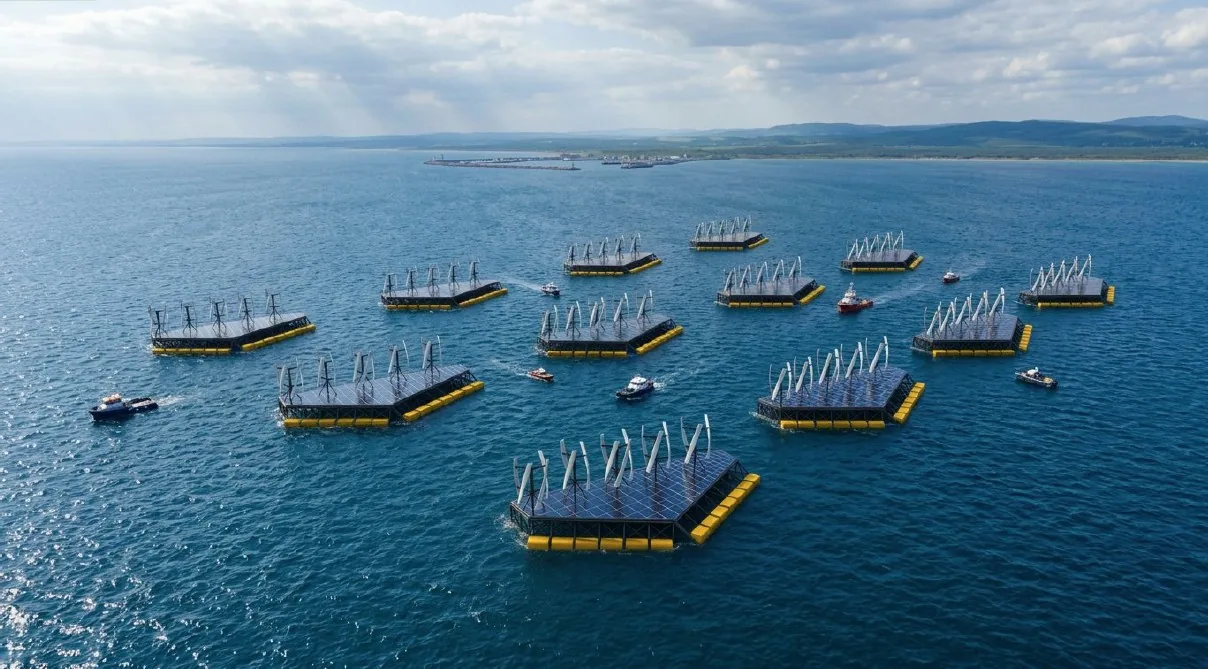
Offshore renewable development has largely been a search for a better single device. A better turbine. A better float. A better flap. Each of those searches is worth running, and each one ends with a structure in the sea that harvests exactly one thing.
The structure is the expensive part. So is the mooring, the cable, the permit and the vessel time. Asking one of them to carry three sources instead of one is a different kind of improvement, and it is the one NoviOcean went after.
The future of offshore energy will not be single-source systems. It will be hybrid.
Jan G. Skjoldhammer, founder and CEO
What one platform carries
- Wave — the NoviOcean power take-off, a float that rises with the wave and drives a Pelton turbine through pressurised water. The Pelton wheel has run hydropower plants for well over a century; the only innovation is where the pressure comes from.
- Wind — compact vertical-axis turbines on the deck, which work well in close arrangements and in the lower wind layers.
- Solar — lightweight flexible CIGS panels across the deck, chosen for low shading sensitivity and marine suitability.
Not tidal. NoviOcean is a wave, wind and solar platform, and the site says so consistently. How the three fit together is on Technology Ecosystem.
The part that is easy to miss
The three sources do not arrive at the same time. Solar peaks at midday. Wind runs on its own weather cycle. Waves keep going long after the wind has dropped, because water carries so much more mass than air — and as the waves fade, the wind systems are usually rebuilding. Fewer hours with everything low at once means less storage and less backup bought to cover the gaps, and storage is where the system cost hides. The production profiles behind that argument are on Key Advantages.
Where it stands
This is a programme, not a product catalogue. The 1:5 hybrid prototype ran offshore at Svanholmen for fourteen months. measured The NO3 triple-hybrid demonstrator is the current stage. The full-scale Medi Wave 850H pilot is the next major phase, planned for 2027–2028. projected What has been validated, and what has not, is set out plainly on Validation.
If you work on energy projects, investment or manufacturing and the argument holds for you, book a meeting.
Platform images on this page are for illustration only — the actual design is shared in closer dialogues.