
Three offshore projects, or one
Offshore wind, wave and solar have historically needed their own structures, their own moorings, their own cables and their own sea areas. Putting them on one platform changes what the project costs to build and how much sea it uses.
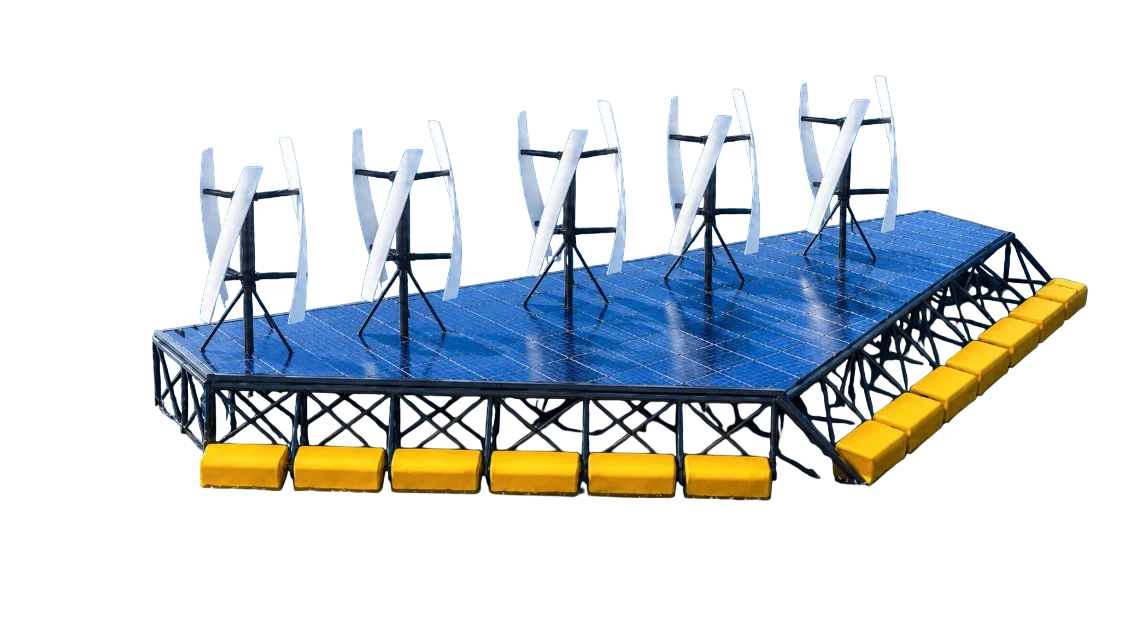
Build offshore wind, and you build a structure, a mooring system, an export cable, a permit, a lease area and a maintenance route. Build offshore solar next to it, and you build all six again. Add wave, and you build them a third time.
Each source carries the full weight of an offshore project on its own. That is the part of offshore energy that has never been about the generator.
What sharing removes
NoviOcean puts wave, wind and solar on one floating structure. One set of everything that is not the generator:
- one hull and one steel structure
- one mooring and anchoring system
- one export cable to shore
- one permit and one lease area
- one installation campaign, one maintenance route, one vessel visit
The three sources are also complementary rather than simultaneous. Solar peaks in the middle of the day; wind runs on its own cycle; waves keep running long after the wind has dropped, because water carries so much more mass than air. The result is fewer hours in which everything is low at once — the argument set out with the production profiles on Key Advantages.
Where the capability comes from
The Medi Wave 850H is rated 850 kW: 300 kW wave, 350 kW wind, 200 kW solar. management estimate About 65 per cent of that rated capacity comes from technologies developed by specialists — Wind Harvest vertical-axis turbines, in substantial full-scale development at approximately TRL 7 and progressing toward TRL 8 and certification, and Midsummer CIGS solar, a commercially established technology at approximately TRL 9. NoviOcean’s own wave system is presently TRL 6 and progressing toward TRL 7, and is built on hydropower principles and industrial components that have been in use for well over a century.
The steel is conventional welded shipyard engineering. Marine integration and final configuration still require engineering and validation — that is the honest state of it, and it is what the development programme exists to close.
What it costs
NoviOcean publishes customer cost as a staged figure rather than a single number, because the number moves with deployment volume:
- Stage A, the commercial pilot: approximately 4–8 c€/kWh. projected
- At 200–1,000 units, fully commercial scale with minimal subsidy: 2–5 c€/kWh. projected
These figures refer to unit-level generation cost, excluding site-specific infrastructure such as grid connection, export cabling or local permitting. The full staged roadmap is on Investor Relations.
Who this is for
Energy investors, operators and future customers — particularly where sea area is constrained, electricity is expensive, or a single offshore project already struggles to justify its own cable. Book a meeting if that is you.
Platform images on this page are for illustration only — the actual design is shared in closer dialogues.