WoodChuck.ai on one platform carrying three sources
WoodChuck.ai published a short clip in which Todd Thomas discusses NoviOcean’s approach: rather than building three offshore projects, put wave, solar and wind on one floating platform.
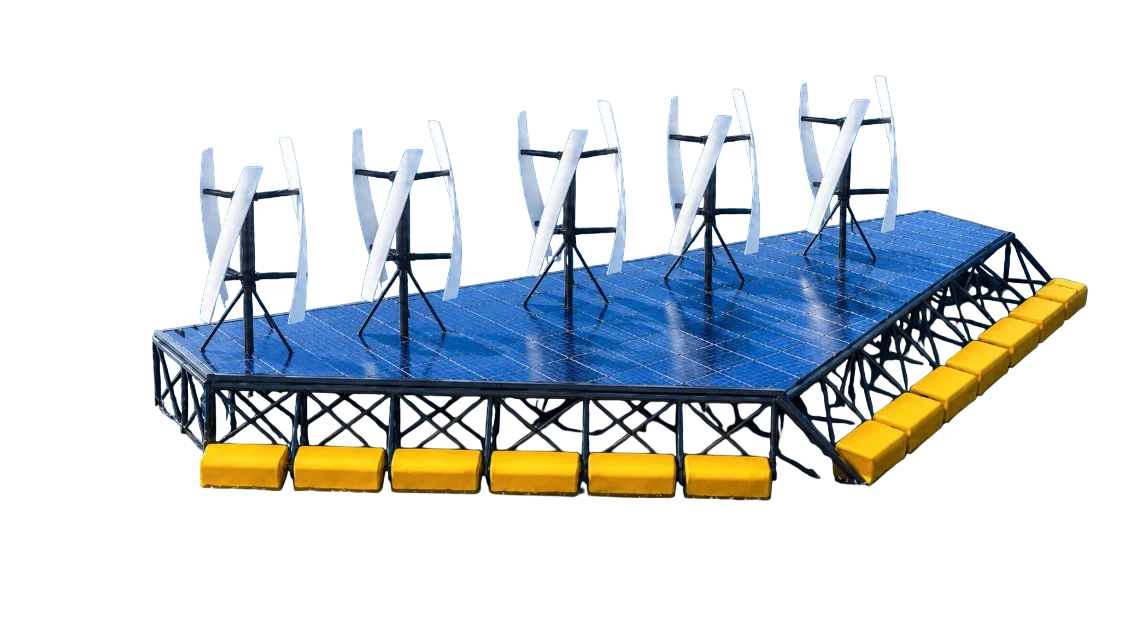
In September 2025, WoodChuck.ai published a short clip in which Todd Thomas discusses NoviOcean. His framing is worth repeating because it is not the one an engineer would reach for first: the design looks unconventional, and the reason it looks that way is the idea underneath it.
The framing, as WoodChuck.ai put it
Use one floating platform to capture wave energy. Put solar on top of it. Add wind turbines to the same deck. Then you no longer need to build, moor, cable and maintain three separate offshore projects to collect three sources. WoodChuck.ai’s conclusion is that this is the sort of outside-the-box thinking that helps clean energy reach scale — innovation, in their words, does not always look the way we expect.
What NoviOcean would add
The observation is right, and it is the design brief. NoviOcean’s own way of stating it is that the expensive parts of an offshore project are the ones that are not the generator — the structure, the mooring, the export cable, the lease area, the vessel time — and that all of them can be shared. The result is 2× the energy of offshore wind from the same sea area. modeled
Two things the clip does not go into, and which matter:
- The three sources are off-phased. Waves keep running long after the wind drops; solar peaks in the middle of the day. Fewer hours with everything low at once means less storage bought to cover the gaps — see Key Advantages.
- Most of the rated capacity is not NoviOcean’s invention. Of the 850 kW rating — 300 kW wave, 350 kW wind, 200 kW solar management estimate — roughly 65 per cent comes from established specialist technologies. NoviOcean’s contribution is the wave system and the integration, and marine integration and final configuration still require engineering and validation.
Where the programme actually stands — what has been tested offshore, and what has not — is on Validation.
Platform images on this page are for illustration only — the actual design is shared in closer dialogues.