
Featured application
Desalination and water security
Freshwater is an energy product before it is anything else. NoviOcean makes that energy at sea, beside the water it treats — and desalination is one of the few large loads that can follow supply instead of fighting it.
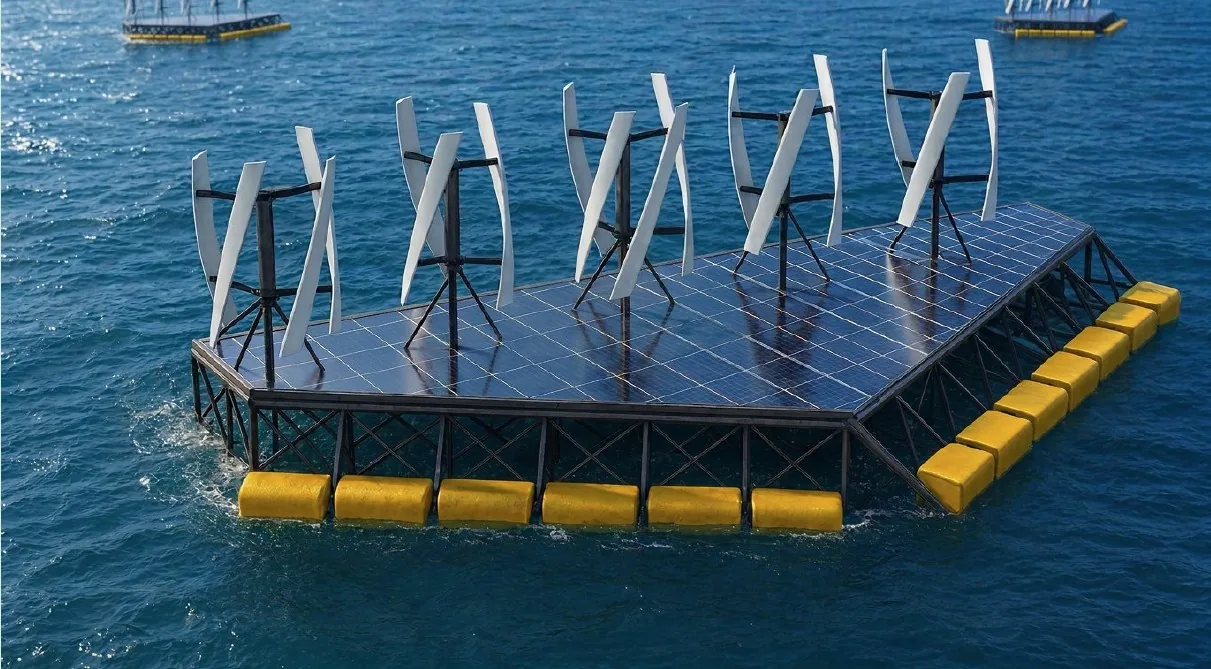
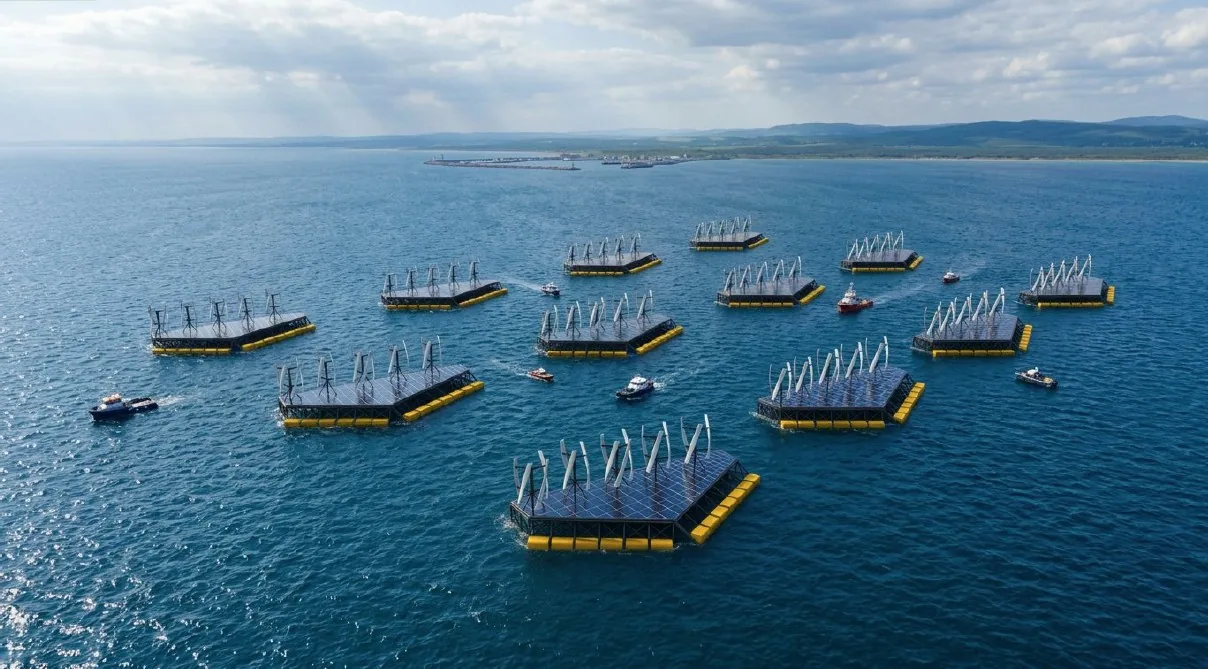
For illustration only — the actual design is shared in closer dialogues.
01 · The customer problem
Energy-intensive freshwater production, in a world facing increasing water stress.
Desalination is not really a water-treatment problem. It is an energy problem wearing a water-treatment label. Once a plant is built, energy is the dominant item in what it costs to run — so the price of freshwater at a site tracks the price of electricity at that same stretch of coast, year after year, for the life of the plant.
That is uncomfortable for three reasons, and on the coasts that need desalination most, the three tend to arrive together.
Energy is the operating cost
Pumps, pre-treatment and membranes draw power continuously whenever the plant is producing. A desalination plant is not a light load that can be tucked into spare capacity — it is a large, steady electrical demand that has to be served whether or not the local grid has room for it. Whatever a site pays per kilowatt-hour is, in effect, what it pays per cubic metre.
The coasts that desalinate often pay the most for power
Plants get built where seawater is close and freshwater is scarce: islands, arid coastlines, isolated resorts, mining and industrial sites far from anywhere. Those are frequently the same places that import fuel by tanker, run diesel generation, or sit at the far end of a long and expensive transmission line. The water is cheap to reach and the energy is not.
Water stress and weak grids overlap
The places under the most pressure to add water capacity are frequently the places with the least electrical headroom to power it. Adding a plant to a constrained network can mean adding generation, storage and backup as well — three projects to procure, permit and finance instead of one, and a longer wait before a single litre is produced.
None of that is fixed by treating water more cleverly. It is fixed by changing where the energy comes from, and when it is used.
Try it
Electricity, or water — which do you need?
A Medi Wave 850H can deliver electricity to a grid or drive desalination directly. It cannot do both with the same energy, so this model makes you choose. Switch modes and set the array size.
Electricity or water, not both. The energy that makes fresh water is the same energy that would otherwise go to the grid. These two modes are alternatives — never add them together.
Illustrative scenario based on representative assumptions. Actual performance depends on location, wave climate, wind, solar irradiation, configuration, load profile and local energy costs. Contact NoviOcean for a site-specific assessment.
The assumptions behind these numbers
| Assumption | Value | Source |
|---|---|---|
| Rated power per unit | 850 kW — 300 wave / 350 wind / 200 solar | Deck slide 6; identical on Technology, Medi Wave 850H, Validation and Simulator modeled |
| Annual production per unit | ~2,500 MWh per year | Deck slide 22 — representative modeled production, not guaranteed for your site modeled |
| Diesel displaced | 400 litres per MWh delivered | Derived from ~1,000,000 litres per 2,500 MWh, deck slide 22 modeled |
| Emissions avoided | ~1 tonne CO₂e per MWh delivered | Derived from ~2,500 t per 2,500 MWh, deck slide 22 modeled |
| NoviOcean energy cost | ~70 €/MWh (~7 c€/kWh) | Conservative end of the Stage A range, 4–8 c€/kWh, deck slide 26 projected |
| Capacity factor | not used | V2 publishes no Medi Wave capacity factor. Annual energy comes straight from the published figure above, never from a capacity factor. estimate |
| Water output per unit | 70,000–100,000 litres per hour | Deck slide 22, stated as the alternative to 2,500 MWh of electricity modeled |
Demand and price above are illustrative defaults, not your site’s figures, and no local wave, wind, solar or demand data has been used. Output is representative modeled production, not a guarantee.
02 · What NoviOcean brings
Power made at sea, for a load that can follow it.
One platform, three sources, one connection
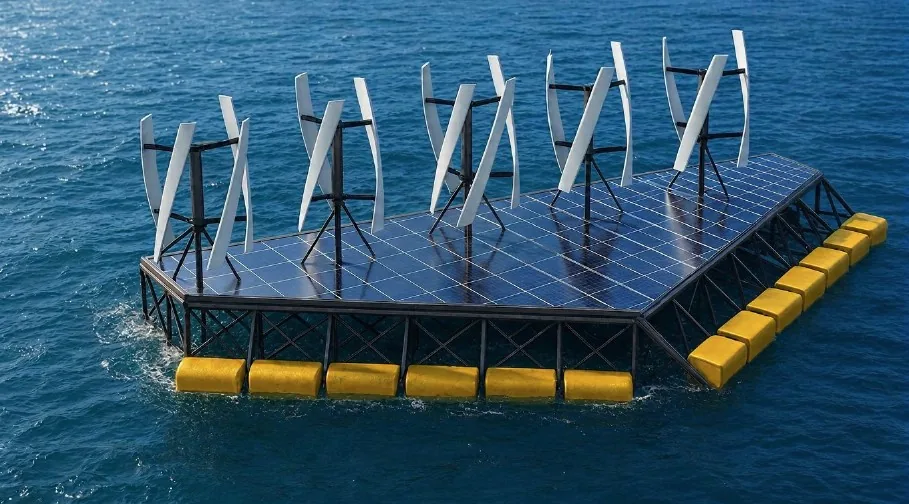
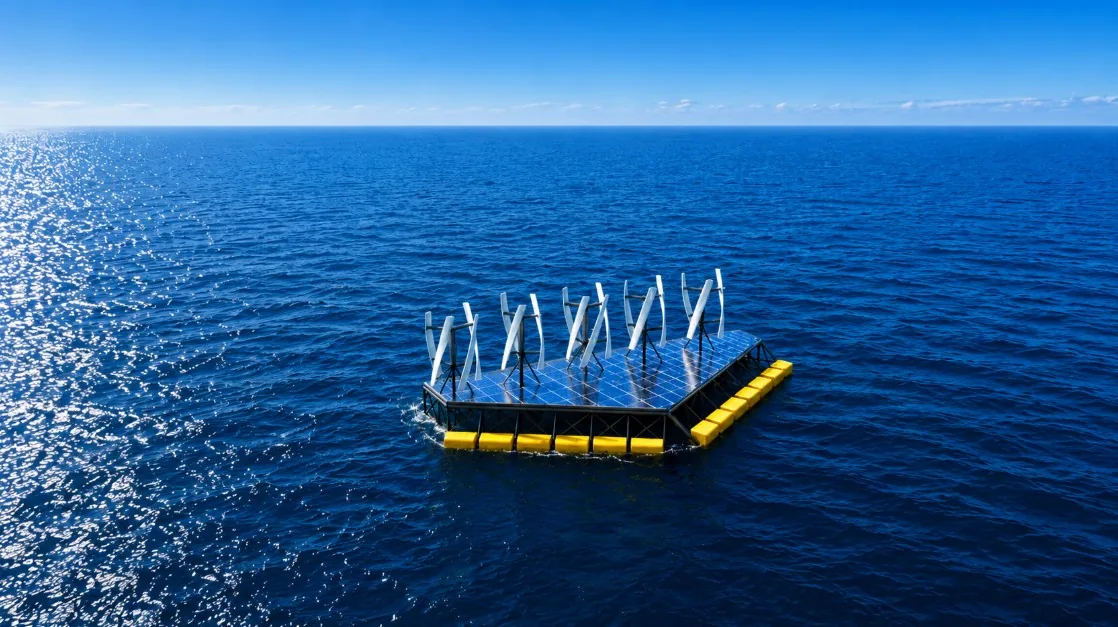
A NoviOcean unit collects wave, wind and solar energy on a single floating structure, with one mooring and one cable to shore. A unit is rated at 850 kW — 300 kW wave, 350 kW wind and 200 kW solar. management estimate Because the three sources rarely peak together, production is spread across more hours of the day and the year than a single-source plant of the same rating.
Desalination can follow supply
Most large electrical loads insist on being served on their own schedule. Desalination is one of the few that does not. Within the limits of its tanks, its membranes and its delivery obligation, a plant can run hardest when energy is abundant and throttle back when it is not — storing the product as water rather than as electricity.
That matters for a plant whose output varies with sea and sky. A load that can move toward the energy needs less stored energy than a load that cannot: the storage question changes from sizing a battery for the whole demand to sizing it for the gap. It also changes what a low-production hour costs, because a paused membrane train is an inconvenience, not an outage.
Water made where the energy is
The platform is designed to carry containerised equipment on deck — desalination, battery storage, or both. management estimate Treating seawater on the platform means the energy does no travelling before it does any work: what leaves the unit can be product water rather than only electricity, and the feed is drawn from the sea the platform is already floating on.
Two descriptions of the same unit, not two outputs to be added together. Energy spent making water is energy that does not leave as electricity. modeled
The split between the two uses is a project decision, not an additive total — a unit that spends its energy desalinating is not also exporting that energy as electricity, and any mix of the two lands somewhere between the branches rather than at the sum of them. Both figures describe one unit in representative modeled operation; actual output depends on the site’s wave climate, wind, solar irradiation, the final configuration and the desalination process chosen. Source: NoviOcean Extended Presentation, slide 22.
Where the two problems are one problem
On an island, water and power are the same line in the budget.
An arid coastal town or a small island rarely has a water problem and an energy problem separately. It has one problem: what it needs has to be made locally or shipped in, and both are priced off imported fuel. The tanker arrives, the fuel runs the generators, the generators run the water plant — so the cost of a litre of freshwater is effectively set a long way offshore, by something the community does not control.
Which is why the two projects are usually worth planning together rather than in sequence. A unit sized against an island’s electrical load and a unit sized against its water demand are the same hardware; choosing between them becomes an operating decision rather than a second procurement. Where demand is seasonal — a resort, a fishing town, a summer population — that flexibility cuts both ways: capacity that makes water when the tanks are low can export electricity when they are full.
03 · A possible project pathway
How a first water project would actually start.
No two coastlines make water on the same terms, so this is a route rather than a product. It is written the way a first conversation with an operator or a local authority tends to go.
Step one — a demand and discharge study
A water-demand and brine-discharge study with the local authority or the plant operator: how much freshwater is needed, when it is needed across the year, what quality the feed water is, and where the concentrate goes. This comes before anything is sized, because it is the part that decides whether a site works at all.
Step two — a first unit with containerised treatment
One unit with containerised treatment on board, sized to a defined daily volume rather than to the platform’s rating — and measured against a baseline the operator already recognises: what water costs to produce today, and what it costs to power the plant that produces it.
Step three — add units as the demand does
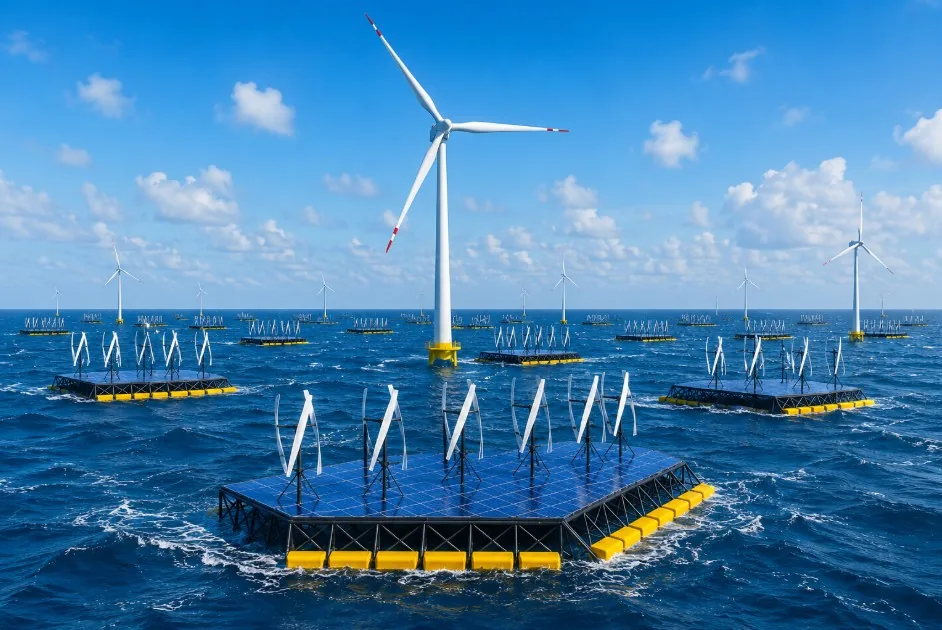
Additional units as demand grows, or as a site moves from seasonal supply to year-round supply. Ownership can sit with the utility, with a project company, or with a partner that operates the plant and sells water, electricity, or both.
What the platform brings to a water project
- Generation on site: wave, wind and solar collected on one floating structure
- One mooring and one connection to shore, whichever product leaves the platform
- Deck space for containerised desalination and/or battery storage
- A load that can be scheduled against the energy actually available
What stays with the project, not the platform
- Brine discharge design and its environmental assessment
- Marine and water permitting, which is site-specific in every jurisdiction
- Feed-water quality, pre-treatment and membrane selection
- Onshore storage and distribution of the product water
This split is worth being blunt about. Brine discharge and permitting are site-specific and they sit with the project, not with the platform — NoviOcean supplies the energy and the deck it stands on, while the water plant’s environmental case is made locally, with the local regulator, on the local evidence.
Related applications
The same platform, sited for a different job.
Water is one of approximately twelve credible applications for the platform. management estimate These three sit closest to it.
How much water, and what does it cost you today?
Tell us the site, the daily volume you need and what powers the plant now. We will tell you honestly whether a NoviOcean unit is a sensible fit for it — and if it is not, we will say so.