Company
The technology ecosystem behind the platform
Solar from Midsummer. Vertical-axis wind from Wind Harvest. A welded-steel structure built the way ships are built. And NoviOcean’s own wave system holding the three together at sea.
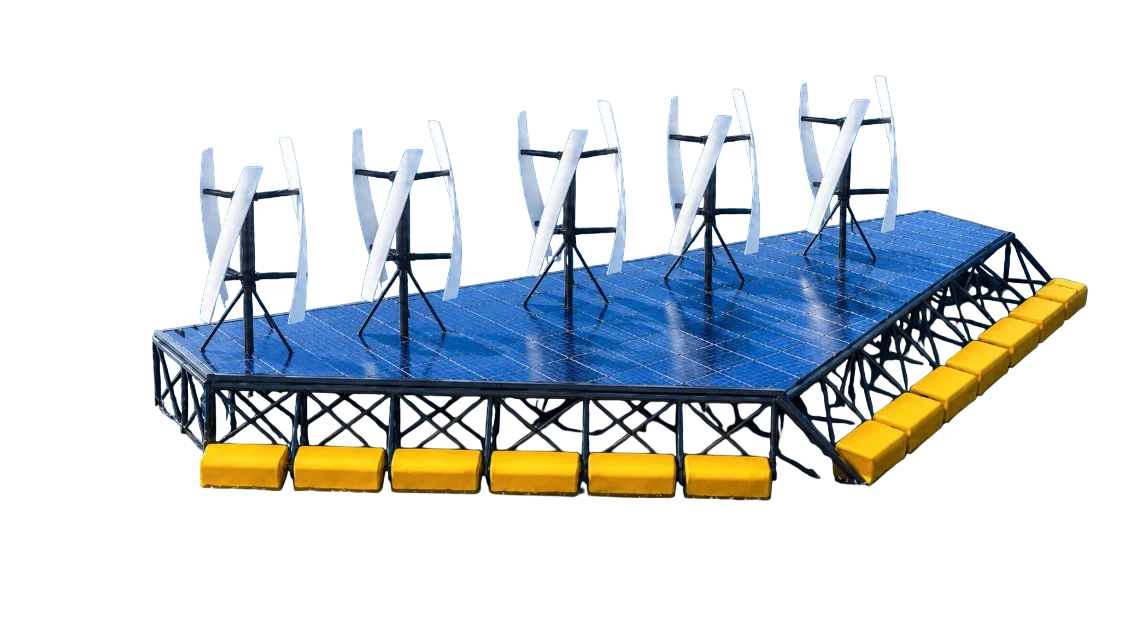
For illustration only — the actual design is shared in closer dialogues.
Why a partner model
NoviOcean integrates. It does not reinvent.
A NoviOcean platform carries three generation sources on one floating structure. Two of them — the solar deck and the vertical-axis wind turbines — come from specialist manufacturers whose technology is already established in its own market. NoviOcean specifies them, mounts them and operates them. It does not develop them.
What is NoviOcean’s own is the wave power take-off, and the integration itself: making wave, wind and solar share one structure, one mooring, one export cable and one operating regime offshore. That is where the company’s engineering effort goes, and it is the part that is still being proven.
Marine integration and final configuration still require engineering and validation.
The technology ecosystem
Four elements, four different states of readiness.
They are presented separately on purpose. A visitor should be able to see at a glance which parts of the platform are already established in their own market, and which parts NoviOcean is still proving. Roughly 65% of rated capacity comes from established specialist technologies. management estimate
Solar — CIGS
Midsummer
Commercially established technology; approximately TRL 9. partner-reported
Lightweight flexible CIGS panels, low shading sensitivity, good low-light performance and a marine-suitable design, laid onto a deck the platform needs anyway.
approximately TRL 9Wind — vertical-axis
Wind Harvest
Substantial full-scale development; approximately TRL 7 completed and progressing toward TRL 8 / certification. partner-reported
Compact vertical-axis turbines that benefit from close placement and run quietly, mounted on the platform rather than on a tower of their own.
~TRL 7 completed → TRL 8 / certificationFloating steel structure
Shipyard construction
Conventional welded-steel shipyard engineering and established marine construction methods. management estimate
The methods are established. Validation of NoviOcean’s final integrated structure is a separate step, and it belongs to the pilot programme.
established methodsWave system
NoviOcean
Presently TRL 6 and progressing toward TRL 7. management estimate
Based primarily on established hydropower and industrial components and principles used for more than a century.
TRL 6 → 7Technology-readiness levels on this page are screening self-assessments made by NoviOcean and its partners. They are not independent certifications.
The 65% split
Two-thirds of the rated capacity comes from technologies someone else has already proven.
Rated capacity is what the equipment is nameplated at. Annual production is what a site actually yields, and it depends on the wave climate, the wind, the irradiation and the configuration. The two therefore split differently, and both are shown.
Rated capacity is the installed nameplate; annual production is modelled and site-dependent. Marine integration and final configuration still require engineering and validation.
The same split is published on the Technology page → and used by the scenario simulator → — one set of numbers across the site.
Wind — vertical-axis turbines
Wind Harvest
Wind Harvest builds compact vertical-axis wind turbines for the lower, more turbulent air layer that tall horizontal-axis machines are not designed to work in. On a NoviOcean platform that is exactly the layer available: the turbines stand on the deck the structure already provides, close to the water, with no tower and no foundation of their own.
Because the platform carries them, a turbine that would otherwise need its own mast, its own transport and its own installation vessel becomes a deck-mounted module.
Substantial full-scale development; approximately TRL 7 completed and progressing toward TRL 8 / certification. partner-reported
- Compact vertical-axis design No yaw mechanism and no long horizontal blade sweep, so the machine tolerates shifting, turbulent wind directions instead of fighting them.
- Benefits from close placement Output improves rather than degrades when units stand near one another, so several turbines can share one deck — the opposite of the spacing rule that governs horizontal-axis wind farms.
- Modular 50–75 kW units The rating is set per project by adding or removing modules rather than by redesigning the machine. partner-reported
- Quiet operation Relevant wherever a platform is moored within sight or earshot of a community, a resort or an aquaculture site.
Solar — thin-film CIGS
Midsummer
Midsummer is a Swedish manufacturer of thin-film CIGS solar cells. The platform needs a deck in any case — for access, for equipment and for the structure itself — so the deck becomes the solar array, and the solar contribution costs no additional sea area, no additional mooring and no additional cable.
Thin-film matters offshore for reasons that have little to do with peak efficiency: weight, tolerance of partial shading and behaviour under grey northern skies.
Commercially established technology; approximately TRL 9. partner-reported
- Lightweight and flexible Every tonne carried high on a floating structure has to be paid for in buoyancy and stability. Thin film adds far less mass than framed glass panels and follows the deck rather than sitting on a sub-frame.
- Low shading sensitivity Turbine masts and deck equipment throw shadows that move all day. CIGS loses less output to partial shading than conventional crystalline modules.
- Excellent low-light performance Useful production continues under overcast skies and at low sun angles — the ordinary condition in northern and mid-latitude waters.
- Marine-suitable design Built for the salt, spray and movement of an offshore deck rather than for a stationary roof.
The structure
Built the way ships are built.
The floating structure uses conventional welded-steel shipyard engineering and established marine construction methods. There is no exotic material, no bespoke production line and no new manufacturing discipline to invent — which is why the structure can be fabricated by yards that already exist, in the country that will use the platform.
Those methods are established. Validation of NoviOcean’s final integrated structure — the whole platform, with wave, wind and solar on it, moored and operating — is a separate step, and it belongs to the pilot programme rather than to the yard.
Local industrial fabrication
Hulls and structures suit national shipyards and existing local suppliers, using conventional welded-steel marine construction rather than a specialised facility built for one product.
Job creation across established trades
The work spreads across the marine, steel, electrical and offshore sectors — in yards and ports that already hold those skills, rather than in a new industry that has to be trained from nothing.
Regional export-hub potential
A yard that builds units for its own coastline is positioned to supply neighbouring markets from the same facility.
Domestic-production outcomes depend on the yard, the country and the order book. management estimate
The customer-facing view of the same argument sits with the wider opportunity set on Further Applications →
Configuration
The configuration is project-dependent.
Turbine number, turbine rating and photovoltaic area remain project-dependent — typically five to seven modular 50–75 kW vertical-axis turbines and approximately 1,000–1,300 m² of solar deck. management estimate
A site with a strong wave climate and modest wind is not configured like a site with the reverse. The four elements stay the same; how much of each goes onto the deck is decided per project, with the customer.
The wider network
Who funded it, who tested it, who builds it.
Wind Harvest and Midsummer supply the technology on the deck. Behind them is a longer list: the public bodies that financed the development, the universities and institutes that modelled and tank-tested the machine, and the industrial suppliers who fabricate and moor it.
Funding partners, incubators and investors
The public programmes, agencies and incubators that have financed the development, and the private investors alongside them.



Academic and knowledge partners
The universities, institutes and test facilities that have modelled, tank-tested and reviewed the machine.


Industrial partners
Suppliers and industry bodies working on the parts that go in the water — moorings, seals, fabrication and sector representation.
Talk to the people integrating it.
Supplier, yard, utility or project developer — the fastest way to understand how the four elements would be configured for a specific site is a short introductory meeting.