
More stable, from the same square kilometre
The interesting property of a hybrid offshore platform is not that it produces more. It is that it produces more steadily — and steadiness is what storage is normally bought to fake.
Ask what an offshore project costs and the answer usually stops at the generator. It should not. A source that disappears for long stretches has to be covered, and covering it — with batteries, with fossil backup, with overbuilt capacity — is where a large part of the real system cost sits.
Which is why the useful question about a hybrid platform is not how much it produces. It is how often it produces nothing.
Wave and wind are off-phased
Solar heating drives the atmospheric wind systems. Wind transfers energy into ocean waves over time and distance. Because water carries so much more mass than air, waves continue long after the winds subside — and as the waves gradually decline, the wind systems are rebuilding. The cycle repeats.
Measured production profiles from Galway Bay, Ireland, show what that does to the floor of the output curve: wind alone around 10 per cent baseload, wave alone around 30 per cent, and wind and wave combined 40–50 per cent. measured The charts are on Key Advantages; add solar to the same deck and the daytime shape improves again.
The machine
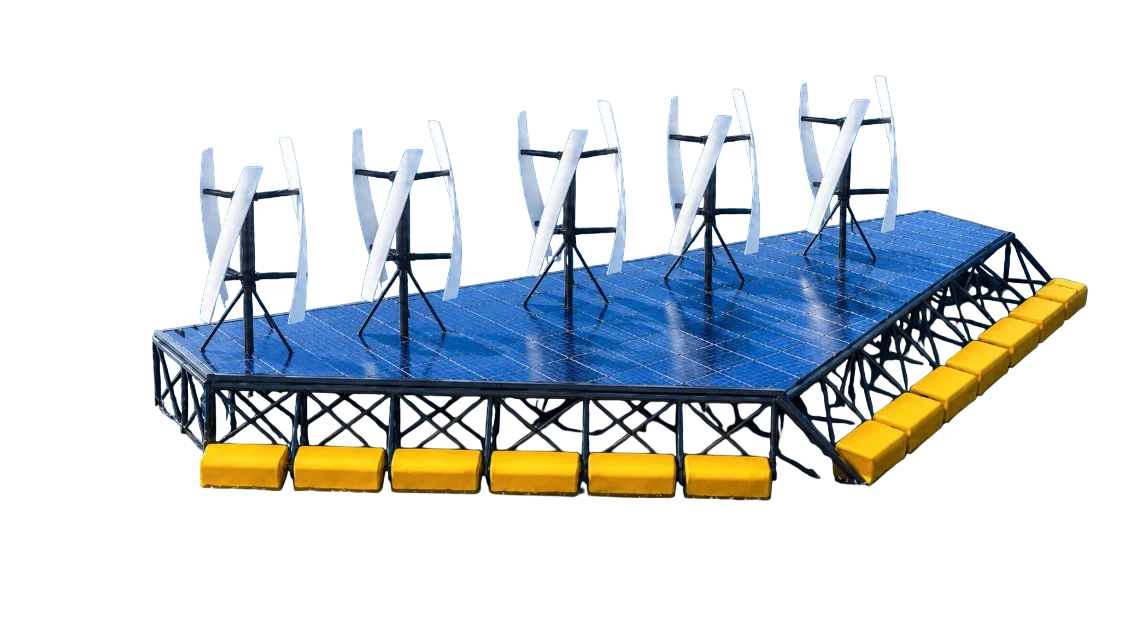
The Medi Wave 850H is the design that applies this to medium and low wave conditions, which is most of the world’s coastline. Rated 850 kW: 300 kW wave, 350 kW wind, 200 kW solar. management estimate Roughly 65 per cent of that rated capacity comes from established specialist technologies — Wind Harvest vertical-axis turbines at approximately TRL 7 completed and progressing toward TRL 8 and certification, and Midsummer CIGS solar at approximately TRL 9. The NoviOcean wave system is presently TRL 6 and progressing toward TRL 7.
Marine integration and final configuration still require engineering and validation. The full-scale pilot is the next major phase, planned for 2027–2028. projected
Why this reads as a cost argument
A steadier output means a smaller battery, fewer diesel hours and less overbuild for the same delivered reliability. That is the whole of it: cheap generation alone is not enough — the full energy system is what a customer actually pays for. The system-level comparison is on Key Advantages, and the staged customer cost is on Investor Relations.
Would you want to see this in your region? Build an illustrative scenario, then book a meeting and we will talk about your actual site.
Platform images on this page are for illustration only — the actual design is shared in closer dialogues.